Career Pathing Software
Career Pathing That is
Defensible and Audit Ready
TalentGuard’s Career Pathing software gives organizations the structured framework to define, validate, and operationalize internal mobility — grounded in skills trust, not assumption.
Most organizations manage careers informally — and pay for it.
When career progression is driven by manager intuition, tenure, or unverified credentials, enterprises inherit a structural liability: talent decisions cannot be validated, internal mobility stalls, and high-performers seek clarity elsewhere.
Opacity in Progression
Employees cannot see what skills are required to advance. Managers cannot objectively assess readiness. HR cannot produce consistent career guidance at scale.
Unvalidated Skills Signals
Job histories, self-assessments, and certification claims are rarely normalized against a governed taxonomy. Decisions rest on data of unknown quality.
No Audit Trail for Talent Decisions
When promotion decisions are challenged — legally, operationally, or culturally — there is no defensible record connecting role requirements to employee readiness.
Behavioral-Based by Design.
The result is not a motivation problem. It is a governance problem — one that requires a systematic, data-backed solution.
Career Pathing Is Where Readiness Intelligence Becomes Visible to the Employee
Talent Assessment validates whether an employee’s current skills are real and at the right proficiency level. Career Pathing takes that verified readiness data and makes it actionable, showing each employee precisely what the next role requires, exactly where their gaps are, and what must change to close them.
It is the Readiness Engine module that answers the question employees ask most: What do I need to do to get there — and how do I know when I’m ready?
The answer is not an opinion or a manager’s informal guidance. It is a governed, role-grounded readiness map, built on the same IRS skill standards that every other talent decision in the platform depends on, with a complete audit trail connecting every career recommendation to the objective criteria behind it.
Maps it. Translates verified skills intelligence into explicit, skills-based routes between roles — so employees can navigate with confidence and organizations can manage internal mobility with precision.
A structured system
— not a suggestion.
Career Pathing is the enterprise practice of mapping explicit, skills-based routes between roles — enabling employees to understand what advancement requires, and enabling organizations to measure workforce readiness with precision.
In the TalentGuard platform, Career Pathing is not advisory. It is operationalized: role requirements are drawn from a governed skills ontology, employee readiness is assessed against those requirements, and every transition recommendation is traceable to a defensible standard.
Four disciplines that make
career decisions defensible.
Governed Skills Ontology
Every role and every skill in TalentGuard is drawn from a curated, enterprise-validated ontology. Role profiles are built on normalized skill definitions — not free-text job descriptions — ensuring internal consistency across departments, geographies, and business units.
Your skills taxonomy is governed, versioned, and extensible.
Role Architecture & Ownership
Career paths are not crowd-sourced. They are defined by HR architects with organizational authority, maintained by role owners, and governed through approval workflows. Every path reflects deliberate organizational design — not aggregated employee preference.
Ownership, approval, and version control at the role level.
Assessed Skill Alignment
TalentGuard measures employee readiness against each target role’s governed skill profile. Readiness scores are calculated from verified assessments, manager evaluations, and developmental activity — not self-reported claims alone.
Quantified gap analysis. Not guesswork. Not subjective impressions.
Defensible Career Records
Every career path recommendation, readiness assessment, and progression decision is logged against the governing skill standard at the time the decision was made. This creates an immutable record connecting talent outcomes to objective criteria — suitable for review, compliance, and reporting.
A complete audit trail for every internal mobility decision.
governed intelligence system woven into how the enterprise understands, develops,
and deploys talent.
Built for enterprise governance. Designed for employee clarity.
TalentGuard Career Pathing delivers a complete capability set — from skills architecture through employee-facing career exploration — governed by a single platform logic.
Role-to-Role Mapping
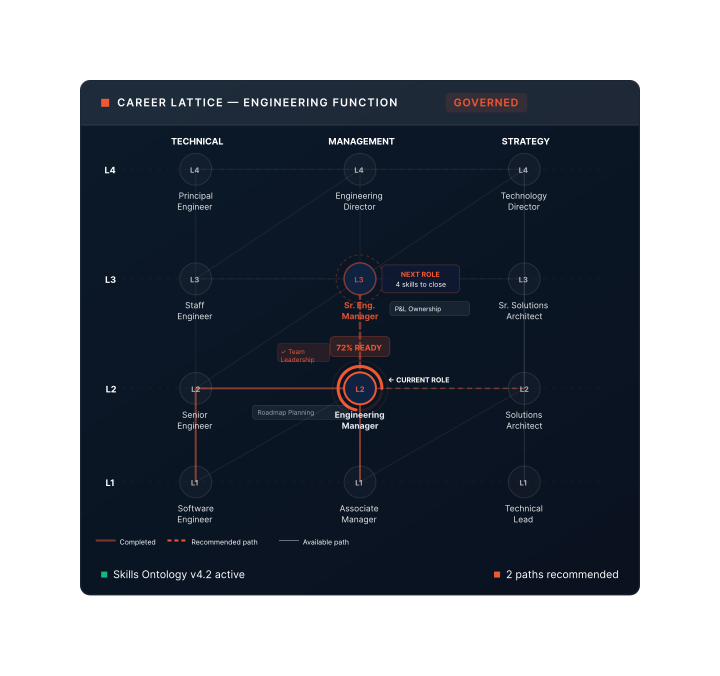
Define lateral, diagonal, and vertical transitions between any roles in the organization. Each path is built from governed skill gap analysis — not organizational chart proximity alone.
Readiness Scoring & Gaps
Every employee’s current skill profile is measured against each target role’s defined requirements. The platform surfaces quantified readiness percentages and ranked skill gaps — not qualitative summaries.
Skill Ontology Management
Manage a normalized, versioned skills library that serves as the single source of truth across Career Pathing, Succession, and Learning. Govern skill definitions, proficiency levels, and role associations centrally.
Career Lattice Visualization
Employees see all viable paths — upward, lateral, and across functions — rendered as an interactive lattice tied to real skill requirements. The visualization is governed data, not aspirational diagram.
Development Plan Integration
Gap-closing activities — courses, projects, certifications, mentoring — are mapped to specific skill deficits on each career path. Plans are generated from the gap analysis, not from generic L&D catalogs.
Governance Logging
Every role profile change, assessment, and career recommendation is time-stamped and linked to the governing skill standard. HR, legal, and compliance teams have a complete, retrievable history of career decisions.
From skills architecture to
audit record — in one system.
with a governed skill profile drawn from the ESTRI ontology — specifying required skills, proficiency levels, and proficiency weightings. Role owners review and approve profiles through a structured workflow.
One platform. Multiple stakeholders.
TalentGuard Career Pathing delivers a complete capability set — from skills architecture through employee-facing career exploration — governed by a single platform logic.

FAQs