360-Degree Feedback
Opinions Don’t Defend
Talent Decisions
Evidence Does.
TalentGuard’s 360-degree feedback converts multi-rater behavioral observations into governed, calibrated competency evidence that drives a talent decision.
THE PROBLEM
High-Stakes Talent decisions are being made on data that wouldn’t survive an audit.
Succession decisions. Executive development investments. High-potential designations. These are the decisions with the greatest organizational consequence — and in most enterprises, they are made primarily on managerial perception, political visibility, and institutional memory.
That is not a data problem. It is an evidence problem.
Skills assessments tell you what an employee claims to know. Certifications tell you what they’ve been credentialed for. Neither tells you how they actually operate under conditions that matter — how they lead, collaborate, influence, and execute in practice, as observed by the people working with them every day.
Multi-rater behavioral feedback is the evidence layer that closes this gap. But only when it is governed: anchored to validated competencies, collected from structured evaluator groups, calibrated for bias, and connected to decisions in a traceable record.
| 01 | Perception Without Evidence Promotion and succession decisions rely on managerial gut feel rather than structured, multi-source evidence — creating legal exposure and talent loss. |
| 02 | Fragmented Feedback Signals Feedback exists across annual reviews, pulse surveys, and 1:1s — siloed, inconsistent, and impossible to aggregate into a coherent talent picture. |
| 03 | No Auditability When challenged, HR leaders cannot demonstrate how talent decisions were made, what data informed them, or whether standards were applied consistently. |
| 04 | Skill Gaps Go Undetected Without structured multi-rater assessment, critical competency deficiencies remain invisible until they manifest as performance failures or attrition. |
AUTHORITATIVE DEFINITION
What 360-Degree Multi-rater Feedback Actually is
360-degree feedback is a structured competency assessment methodology that collects behavioral and performance observations from multiple evaluator groups — managers, peers, direct reports, and the individual — to produce a complete, calibrated view of how an employee operates in practice.
Unlike single-source reviews, multirater feedback eliminates individual evaluator bias by triangulating signals across relationship types. The result is not a popularity metric — it is a calibrated competency signal that reflects an individual’s actual demonstrated behaviors against defined organizational standards.
In an enterprise context, 360 feedback becomes the evidentiary foundation for development planning, succession readiness scoring, and role-fit assessment — decisions that carry significant organizational and legal weight.
360° vs. Traditional Review
| AREAS | TRADITIONAL | 360° MULTIRATER |
| DATA SOURCES | Manager only | 4+ evaluator groups |
| BIAS CONTROL | None — single perspective | Triangulated & calibrated |
| COVERAGE | Outcome-focused | Behavioral & competency-based |
| AUDITABILITY | Subjective, indefensible | Governed, traceable |
| DEVELOPMENT VALUE | Limited self-awareness | Full gap identification |
The 360° Evaluator Ecosystem
Beyond the self assessment, many evaluators can be included.
Direct Manager
Evaluates goal alignment, leadership behaviors, and strategic execution from a positional authority perspective.
Peers
Assess collaboration, communication, and cross-functional effectiveness from a lateral working relationship.
Direct Reports
Surface people-leadership behaviors — coaching quality, delegation, and psychological safety — invisible to upper management.
Cross Functional
Optional stakeholder group for roles with significant internal or external customer interaction.
Effective 360 feedback is built on a custom competency framework or ad hoc questions. TalentGuard maps every feedback cycle to your approved skills taxonomy, ensuring evaluations measure what the organization has defined as meaningful.
- Competency mapping
- Standardized indicators
- Strategy alignment
- Consistent vocabulary
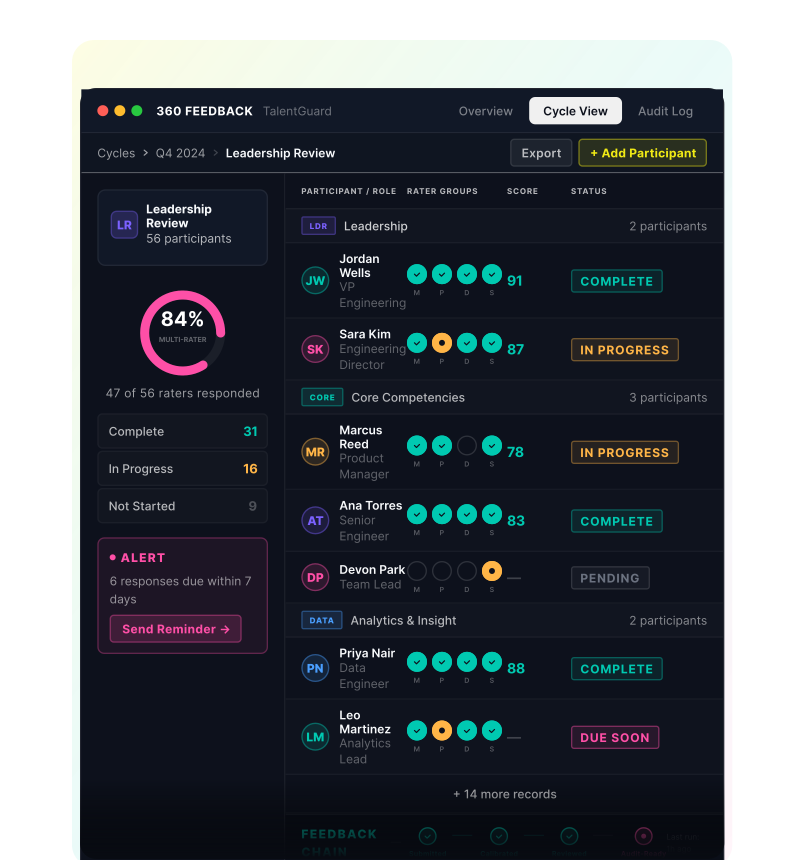
A single evaluator perspective is a bias vector. TalentGuard’s platform systematically collects structured feedback from manager, peer, direct report, and self-assessment channels — with configurable rater selection, anonymity controls, and completion enforcement.
- Configurable groups
- Anonymity enforcement
- Completion tracking
- Rater moderation
TalentGuard’s reporting allows organizations to configure exactly what insight appears in a 360 report. Rather than presenting raw ratings in isolation, the report builder assembles calibrated analysis sections that reveal perception gaps, alignment, and insight.
- Reviewer analytics
- Self-perception gaps
- Reviewer comparison
- Configurable sections
Every 360 cycle in TalentGuard produces a timestamped, traceable record of who was assessed, which competencies were measured, what ratings were submitted, and how scores were derived — creating a defensible audit trail for every talent decision downstream.
- Audit trail
- Data retention
- Linked to development
- Multi-program comparison
How 360 Feedback
Works in TalentGuard
Business Outcomes,
Not Feature Lists
TalentGuard’s 360 platform is evaluated by the decisions it enables, not the surveys it delivers. Here is what changes at the enterprise level.
Replace Intuition With Evidence
Organizations using TalentGuard’s 360 data in succession processes report a 40% reduction in high-potential mismatch at critical role transitions. Succession candidates are ranked on calibrated readiness scores — not managerial preference.
- ✔ Succession readiness scoring
- ✔ Multi-rater validation for HiPo identification
- ✔ Reduced succession cycle time by 60%
Identify Gaps Before Issues
Surfaces the gaps that manager-only reviews miss — particularly in people leadership, cross-functional influence, and executive presence. Development investments become targeted, not generic.
- ✔ Blind spot identification through gap analysis
- ✔Development plans linked to gaps
- ✔Development interventions
Defend Every Talent Decision
When talent decisions face legal or regulatory challenge, organizations with TalentGuard 360 records can produce a complete, structured evidence trail — who was assessed, how, against what standards, and what decisions resulted.
- ✔ Full assessment audit trail per employee
- ✔ Documented decision-to-assessment linkages
- ✔Data export in standard formats
See Skill Risk Before It Surfaces
Aggregate 360 data reveals capability gaps that individual reviews cannot surface. HR leaders gain a workforce-wide data that informs hiring, learning investment, and structural decisions.
- ✔ Org-level competency gap visualization
- ✔ Bench strength analysis by function and role
- ✔Risk identification for critical roles